
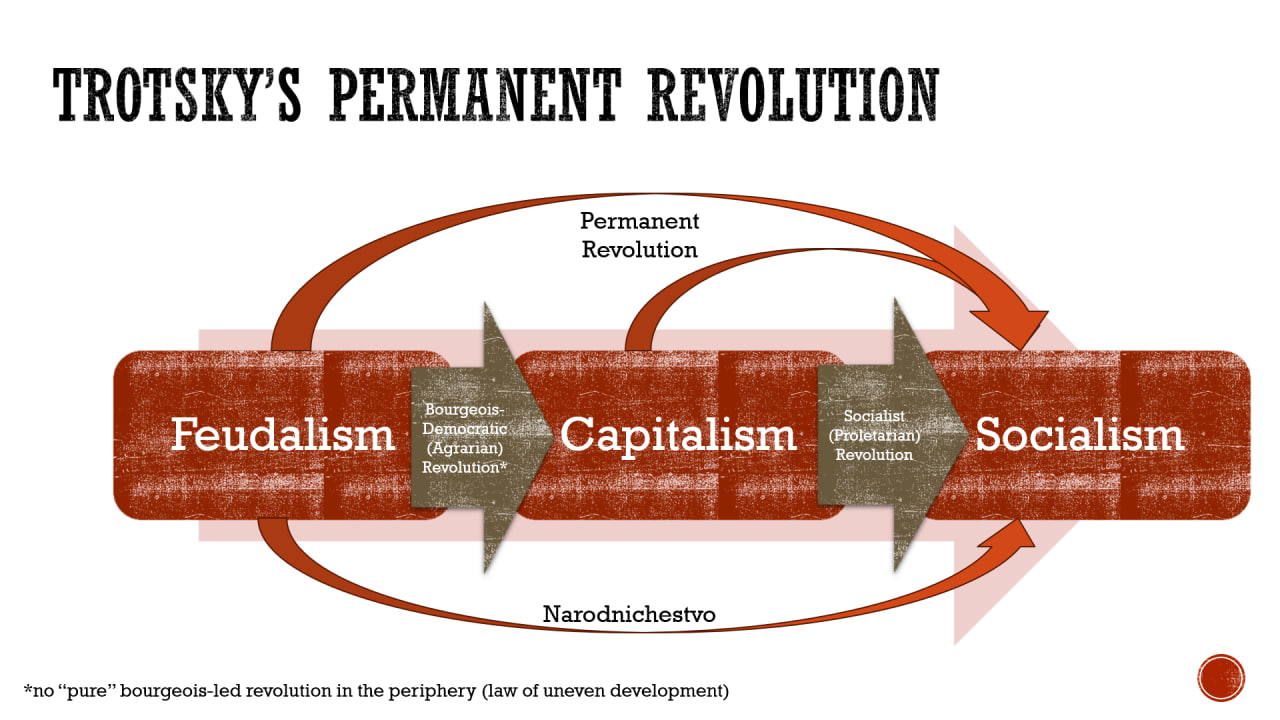
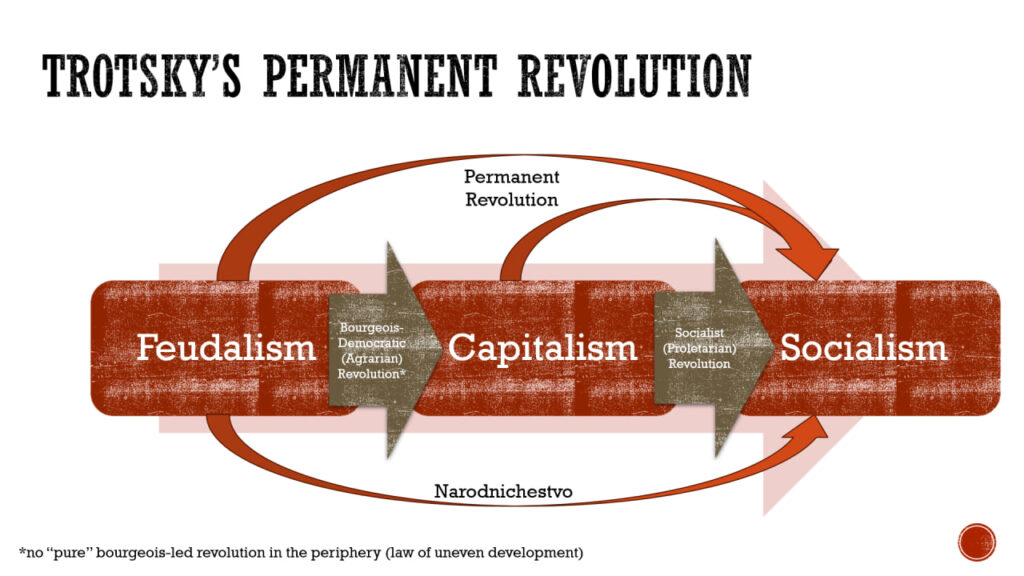
I have made this simple graphic for my students, trying to explain visually what permanent revolution meant as a concept and why it was so relevant in the 20th century. If you’re a Marxist theory nerd like me, you’re probably annoyed by endless misinterpretations (or, more precisely, complete ignorance) of what permanent revolution actually meant. You’ve probably been endlessly annoyed by hearing empty tautologies of permanent revolution being “a revolution that happens permanently” or even emptier assertions that it didn’t work from the superficial scholastics of Terminally Online Stalinism, which kind of miss the point from the very premise (that being they know nothing about it but it must have been bad because it’s associated with Trotsky).
For understanding the revolutionary processes of the 20th century, permanent revolution is an absolutely crucial theory. In short, it subverted what I usually call the “classical” Marxist philosophy of history of the Second International, with which everyone is well familiar:
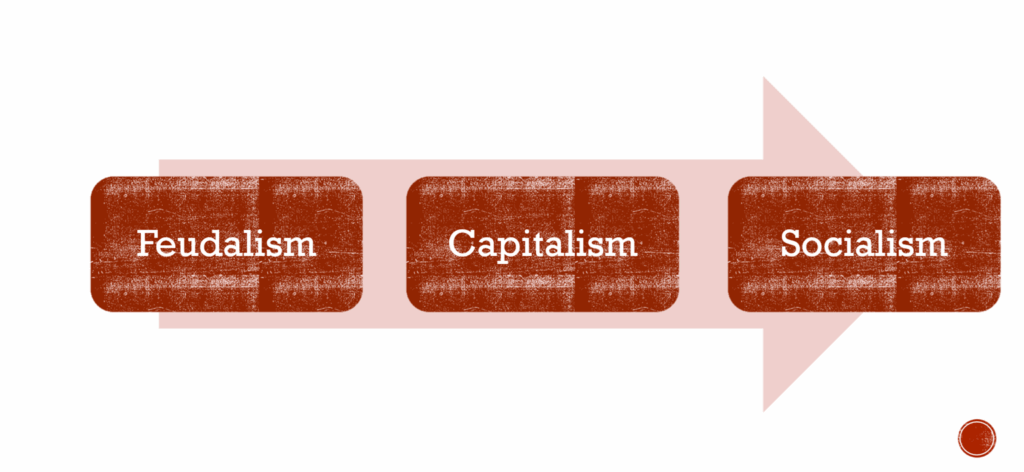
Trotsky (following Parvus) understood that this simplistic model was inapplicable in countries with underdeveloped capitalism (which, in the 1900s and 1910s, was most of the planet). He saw, after the revolution of 1905, that the Russian bourgeoisie was too weak to conduct its bourgeois-democratic revolution. This was a consequence of the uneven development of capitalism at a global scale. However, the peasantry, the other great factor in bourgeois-democratic revolutions, remained militant, and perhaps even more so than in places such as France in the 1790s. Trotsky therefore proposed that the future revolution would have to be the one in which the new class ushered in by capitalism – the proletariat – would take the leading role in an alliance with the peasantry, just as the bourgeoisie had done in the previous great revolutions. In other words, “permanent revolution” merely describes the process which in fact took place in the former Russian Empire over the course of the year 1917. Therefore, the end outcome looks something like this – not a “skipping” of historical stages in the style of Russian populism, but the coming together of various stages of development into a superior one:
For a good and brief selection of excerpts from Trotsky’s writings which summarize the crux of the theory of permanent revolution, see this blog post.