

On July 17, 1936, a revolt broke out, organized by Spanish army generals, against the democratically elected Popular Front government, elected several months earlier. The revolt marked the beginning of a civil war which lasted for almost three years and which to this day inspires many, despite the defeat of the Republic, as a symbol of internationalist working-class solidarity and struggle against fascism.
Under the assumption that, if you have found your way to this blog, you already know something about the Spanish Civil War, the following text will not be dedicated to a general history of the conflict. To those who are interested, I can heartily recommend the book of my friend Vladan Vukliš, Jugosloveni i Španski građanski rat. Here, on the other hand, I would like to share a selection of photographs of figures that I personally hold dear and who were involved in the Civil War in Spain.
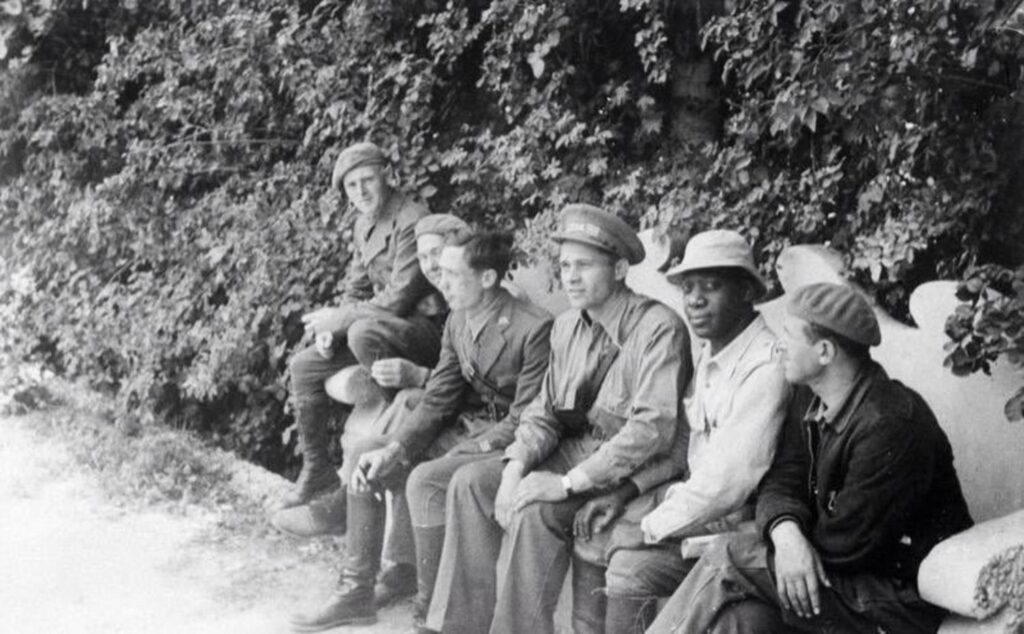
Two Yugoslavs with prominent American and British communists at the headquarters of the 15th International Brigade in the village of Ambite near Madrid in the spring of 1937.
The second person from the left is Steve Nelson (born Stjepan Mesaroš, 1903–1993), hailing from a Hungarian family from the village of Subocka near Pakrac in Slavonia. Mesaroš/Nelson emigrated to the United State in 1920 and became probably the most famous communist of Yugoslav origin in the USA. From 1931 until 1933, he studied in Moscow at the International Lenin School, and in Spain he was the political commissar of the Lincoln Battalion of the 15th International Brigade. He was persecuted for communist activities in the United States, and tried for treason and espionage in favor of the Soviet Union. He left the Communist Party USA in 1957. He worked as a carpenter until his retirement. He was the National Commander of the association “Veterans of the Abraham Lincoln Brigade” and left behind memoirs on his political activities titled Steve Nelson: American Radical.
The fourth person from the left is his friend Mirko Marković (1907–1988), the nephew of the famous Yugoslav communist Vukašin Marković. As a fifteen year old, he was a courier for the guerilla platoon of his uncle; he then studied to be an economist in the USSR; participated in the industrialization of the Donbass; organized Yugoslav communist emigres in the USA; became the commander of the Washington Battalion in Spain; made friends with Ernest Hemingway, with whom he then spent a year in Cuba; upon returning to the US he worked with the Orthodox clergy to organize support for the Yugoslav partisans; after moving back to Yugoslavia, he taught economics at the University of Belgrade before being imprisoned as a Stalinist (twice) following the Tito-Stalin split of 1948; following his release, he became one of the pioneers of cybernetics in Yugoslavia. I recently wrote a detailed Wikipedia biography of Marković (in Serbo-Croatian), which is available here.
Among the many interesting characters sitting with the two of them, the most important is the man sitting to the right of Marović, Harry Haywood (1898–1985), who was the most famous African American communist in the USA. Unlike Nelson, who left the party disillusioned by Stalinism, Haywood saw the distancing from Stalin as opportunism, for which he was expelled from the party. He later became one of the leaders of the Maoist movement in the US. He also left behind a wonderful autobiography titled Black Bolshevik: Autobiography of an Afro-American Communist.
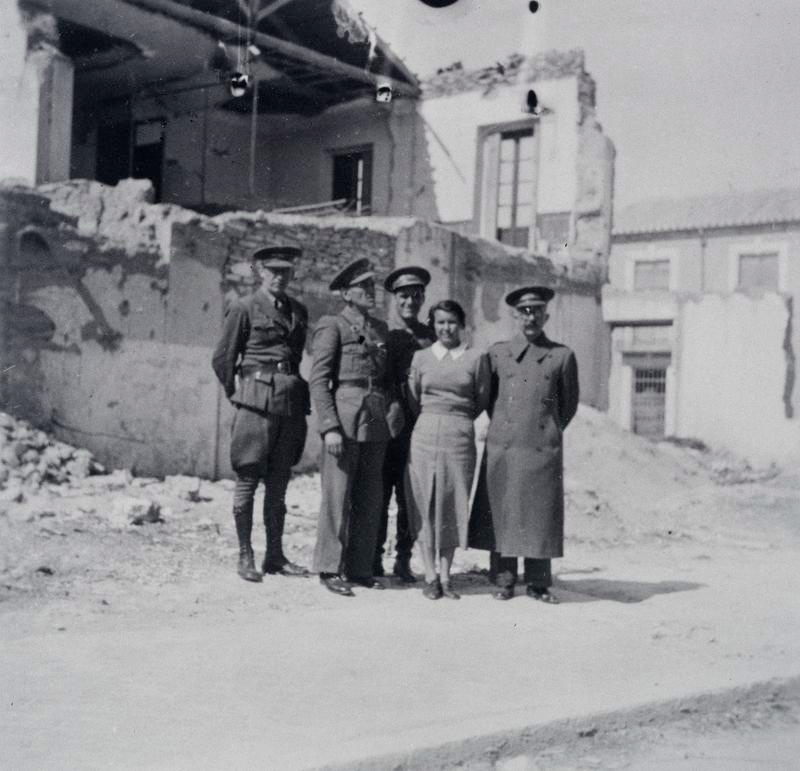
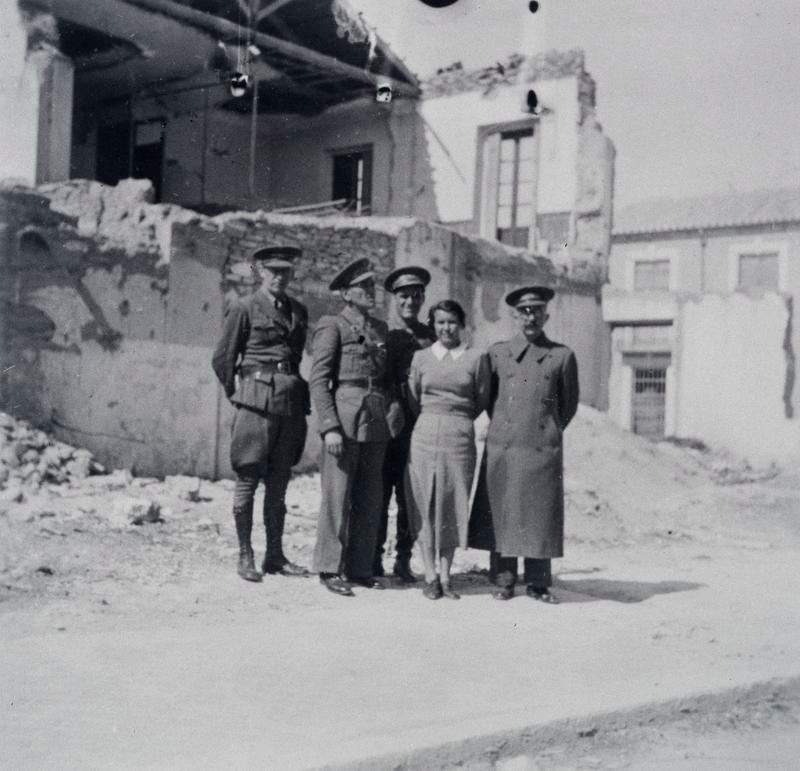
To the right of unknown fighter, we see three Yugoslav communists and a wife of one of them, the Czech communist Sonja Fialova-Ćopić. This photograph was captured on the ruins of the Spanish village of Belchite in the fall of 1937, after the battle in which the village was completely destroyed. From left to right we see Božidar Maslarić, Vladimir Ćopić and Dragotin Gustinčič. All three started out their political careers as Yugoslav nationalists before turning to communism.
Božidar Maslarić (1895–1963) from Dalj in Croatia was a volunteer in the Serbian army in 1914, but became radicalized by the war. He was the most prominent communist organizer in the city of Osijek in the 1920s and one of the leaders of the “right faction” in the Communist Party of Yugoslavia. In the 1930s, he taught at the Communist University of the National Minorities of the West and the International Lenin School. He was Tito’s main associate in Spain, and then a propagandist of Radio “Free Yugoslavia” in Moscow during World War II. Following the revolution, he was the vice-prime minister and then the vice-president of the Parliament of the Socialist Republic of Croatia.
Vladimir Ćopić (1891–1939) a former Croatian nationalist (despite being a half-Serb), became a communist in Russia, where he then participated in the October Revolution. He was the founder and an early leader of the Communist Party of Yugoslavia (KPJ), as well as a member of the Constituent Assembly of the Kingdom of Serbs, Croats, and Slovenes. From the mid-1920s he lived in the USSR and Czechoslovakia, studying and working for the Communist International. He was a member of the Temporary Leadership of the KPJ from 1932 until 1936. In Spain, he was the commander of the 15th International Brigade. Upon returning from Spain to Moscow, he worked closely with Josip Broz Tito to consolidate and reorganize the party leadership, but in November 1938 he was arrested by the NKVD on false charges of espionage. He was shot half a year later. I wrote about Ćopić in great detail in my book Before Tito: The Communist Party of Yugoslavia during the Great Purge (1936-1940).
Dragotin Gustinčič (1882–1974) was a member of the majority-Slovene Yugoslav Social-Democratic Party in Austria-Hungary. In 1914, he emigrated to Serbia, but after the Austro-Hungarian occupation he became disillusioned and turned to communism while in exile. In the 1920s he was one of the leading theoreticians of the KPJ on the national question and a member of the Presidium of the Balkan Communist Federation in Vienna, and then worked for the Balkan Land-Secretariat of the Comintern in Moscow. In Spain, he headed the censorship department of the International Brigades. Like Maslarić, he was a close confidant of Tito. He spent World War II as an evacuee in Tashkent and received a doctoral degree in history. Upon returning to Yugoslavia he was politically marginalized, and thus started gathering around himself dissatisfied communist cadres from the Soviet Union. He was arrested in 1948, even before the Cominform Resolution condemning Yugoslavia, and spent time in prison and on Goli otok until 1954. Upon leaving prison he wrote works of history, literature, and (still unpublished) memoirs.
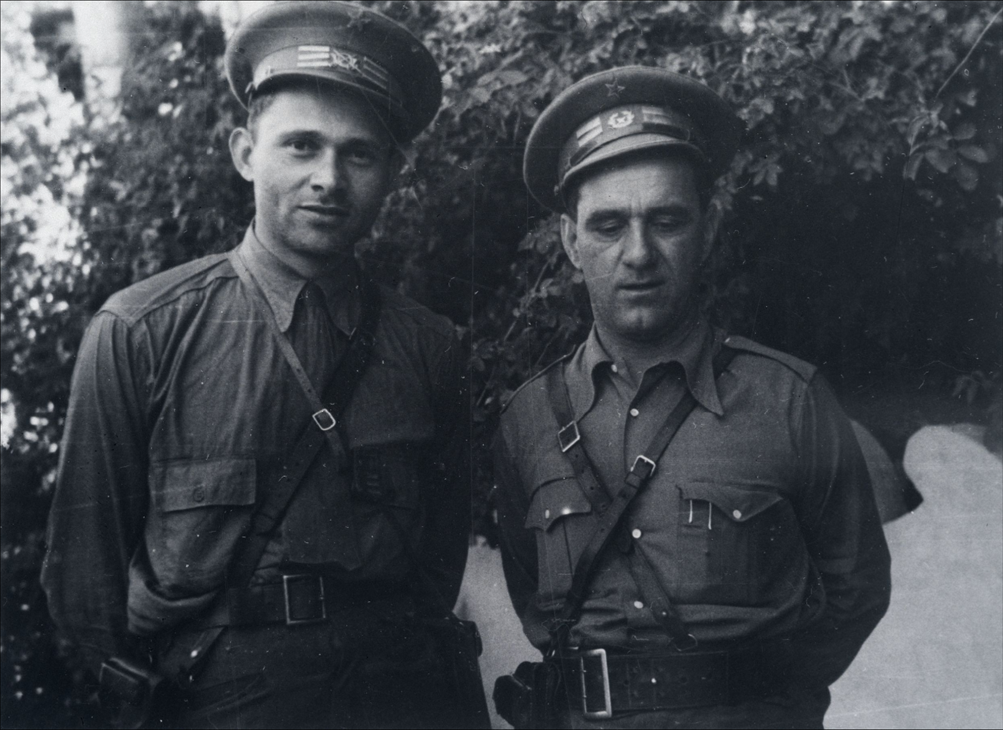
Mirko Marković and Vladimir Ćopić at the headquarters of the 15th International Brigade in Ambite in June 1937.
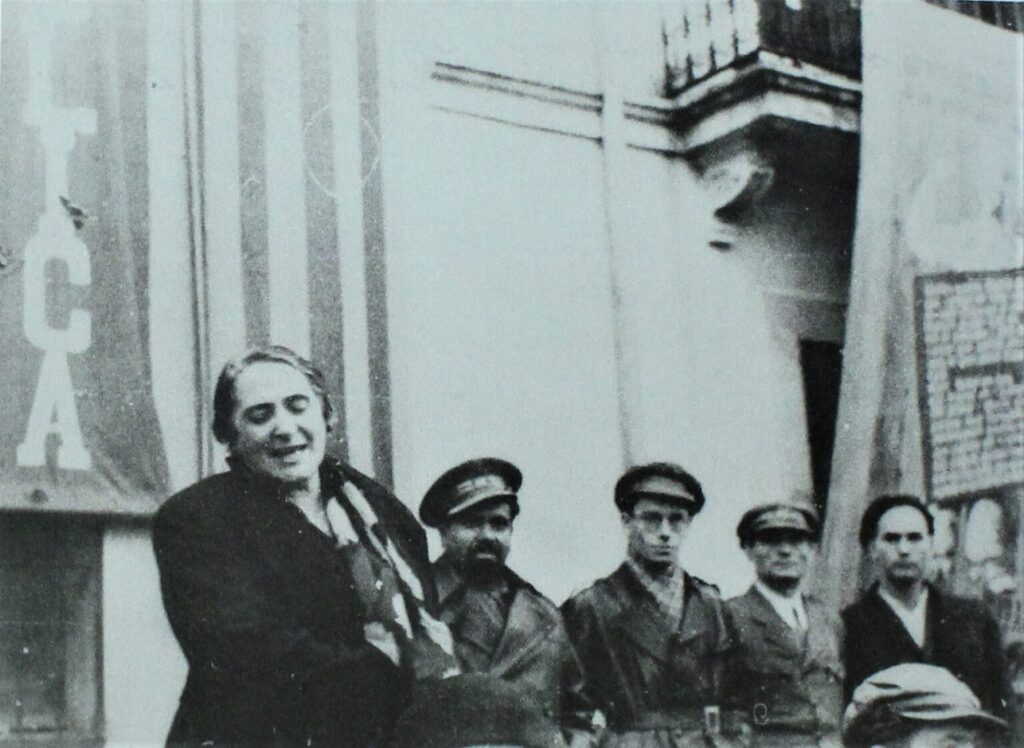
General Secretary of the Communist Party of Spain, Dolores Ibárruri, gives a speech at the farewell ceremony of the International Brigades in Catalonia in October 1938. With her, second from the right, is the Yugoslav volunteer Karel Hatz (1898–1945), a Hungarian typesetter from the region of Baranja. Hatz was a founding member of the Communist Party of Hungary in Pécs and a fighter for the Hungarian Soviet Republic in 1919. In the 1920s, he organized Hungarian communists in Pécs under Yugoslav occupation, and then moved to Novi Sad, where he worked as a typesetter and journalist while illegaly organizing the communist party. After the establishment of the dictatorship in Yugoslavia in 1929, he emigrated to the USSR and began working for the Soviet intelligence. He ran the “Control Division,” the intelligence service of the International Brigades. Upon returning to the USSR, he worked for the Comintern and eventually died as a Red Army soldier in the Battle of Königsberg (now Kaliningrad) in 1945. I also wrote a Wikipedia biography of him in Serbo-Croatian.
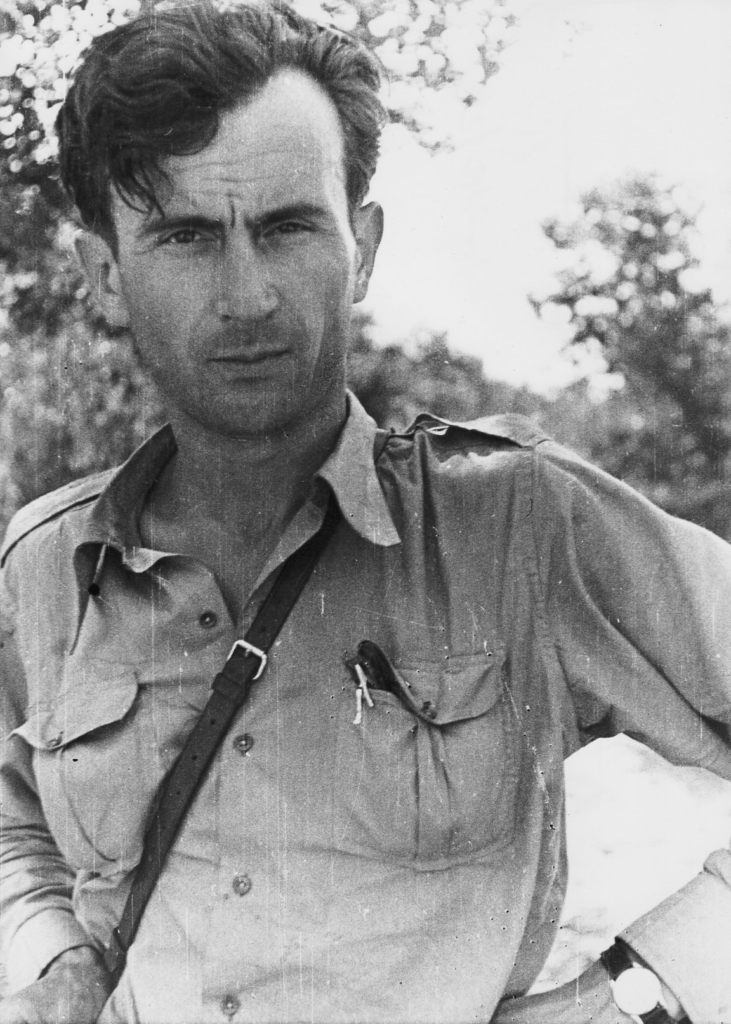
Vlajko Begović (1905–1989) is perhaps my favorite Spanish Civil War volunteer. One could easily write a whole book on Begović, but until someone takes up such a task, I warmly recommend his Wikipedia biography, as well as the article Vladan and I wrote on how Begović was unjustly accused of murdering a comrade, the political commissar of the 13th International Brigade Blagoje Parović.
The two pictures that follow were not taken in Spain, but show figures from Yugoslavia who went there as volunteers.
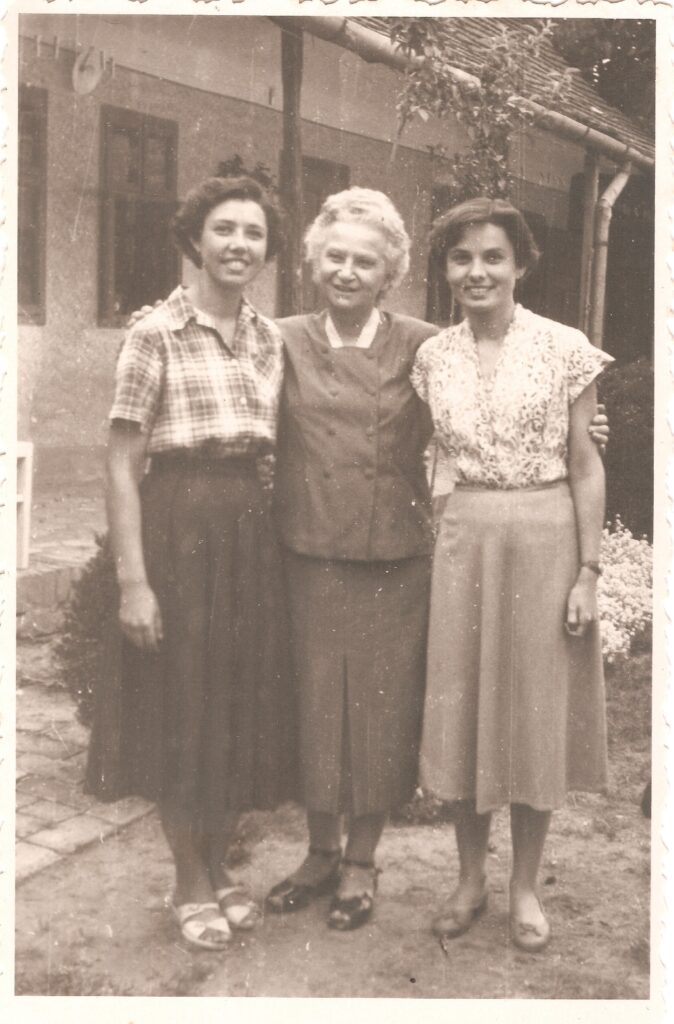
Maria Schneemann (in the middle, born 1896). She was born in my home town, Bačka Palanka, in a Slovak family, as Maria Šul’an. She was a seamstress. In 1928, she left her home town and travelled through Europe looking for work. She lived in Romania, Hungary, Czechoslovakia, Austria, and Germany. In Germany, she met Georg Steinbacher, a member of the Communist Party of Germany, and married him. After the Nazis came to power, the two fled to Yugoslavia and settled in Sarajevo.
In 1937, Maria Schneemann and Georg Steinbacher set on foot to Spain via Slovenia, Austria, Switzerland, and France, to join the defense of the Republic. She was a nurse in Spain, tending to the wounded, while her husband fought in the anarchist militia. In May 1937, both were arrested by the Spanish police for harboring the German Trotskyist Peter Blachstein. They were released following a brief investigation, stayed in Spain until the collapse of the Republic, and then got sent to a concentration camp in France.
After World War II, she lived in France and Germany. The picture shown here, with her nieces, was taken in Bačka Palanka in 1958. Her subsequent fate is unfortunately unknown.
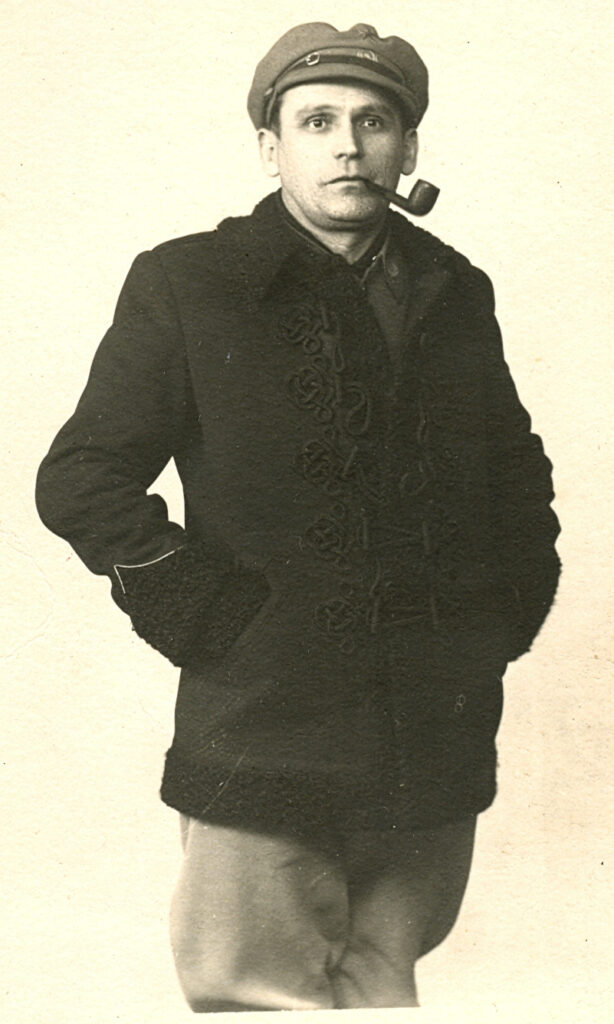
Finally, I would like to mention another Yugoslav veteran of both October and Spain, Nikola Kovačević – Čudnovski (1894–1979), who participated in the fights for establishing Soviet power in Kyiv in 1918 and was one of the founders of the KPJ. After Spain he ended up in the prisons of France and then fought in the French resistance. In Yugoslavia, he was arrested as a Stalinist. He also left detailed and exciting memoirs on his participation in the revolutionary struggles of the second, third, and fourth decades of the 20th century. As they await publication, I took it upon my self to also write a Wikipedia biography of him.
Spain was and remains an inspiration, and is certainly a topic which I will keep coming back to, as many of her fighters deserve to be remembered and immortalized. For today, however, I feel it is enough to share this photo gallery with selected human fates.
Any story of Spain can an must be ended with the verses of the American proletarian poet, the anarchist Al Grierson:
And remember ’til tomorrow as we leave our banners furled
That it only took six days to make, and ten to shake the world
Light a candle for Durruti and we’ll honor all the brave
With a rollcall of the fallen in the dust on Franco’s grave